A camera is a device used to capture images, either as still photographs or as sequences of moving images (movies or videos).
Types
Cameras of different types are used in different professions or on different occasions. Different types of cameras are also used by different professionals, such as engineering, medical and by ordinary people.
How operates (with spectrum light)
Cameras work with the light of the visible spectrum or with other portions of the electromagnetic spectrum.
Consists of
Box
A camera for general use consists of an enclosed hollow with an opening aperture at one end for light to enter, and a recording or viewing surface for capturing the light, at the other end.
Lens
The lens generally is used to admit reflected image from the object. This has an aperture mechanism built in, to vary the light which generally can be adjusted manually.
Viewing plate
This is a ground glass plate at the opposite end of the lens.
After viewing to set the correct focus and the time required for exposure, for the speed or the sensitivity of the particular film or plate to be used, the plate is replaced by sensitive plate or cut film.
Aperture
The diameter of the aperture of the lens is often controlled by a Diaphragm mechanism, but some cameras have a fixed-size aperture.
Use by different professional people
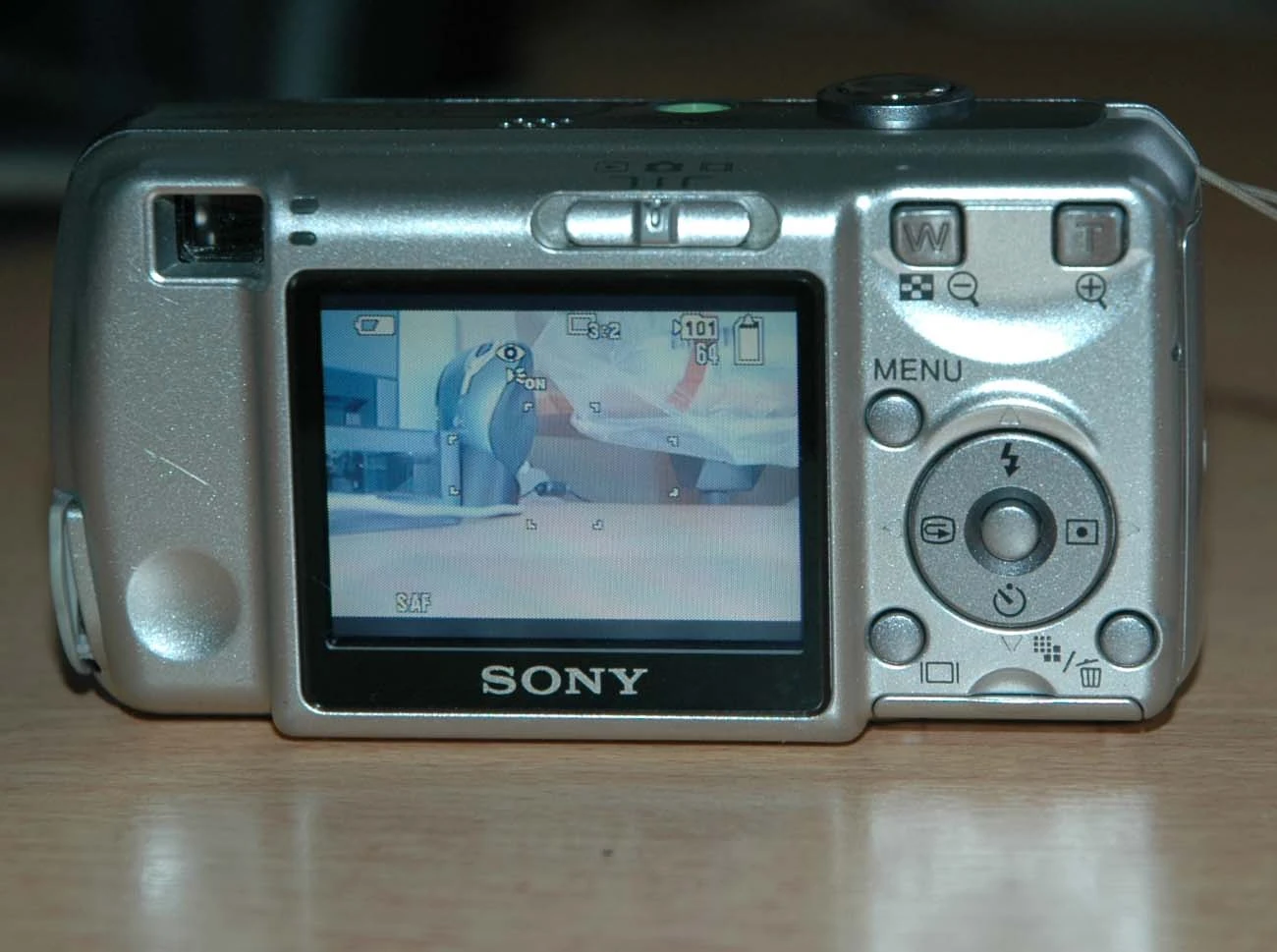

Sony digital camera-Image view
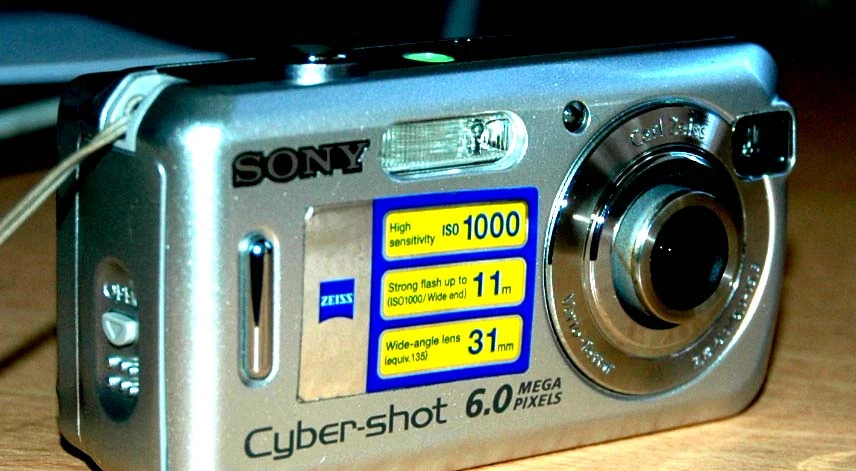

Sony digital camera-lens open
Use by ordinary people
Few years back cameras used to come with films for capturing light. These films have to be processed and printed, generally in the shops, which used to take time and money.
The present day cameras have gone digital in all walks of life. In digital cameras, generally, the aperture adjustments and focus are made automatically by adjusting a wheel, clearly marked of the scene. The lens adjusts itself automatically.
The digital cameras are rated in Mega pixels (more the Mega pixel, clarity is higher and costlier it becomes). This shows the clarity because of CCDs on the viewing screen.
The printing can be done at home with a printer and PC.
Movie cameras have also gone digital as well, with recording on tapes or CDs direct with subsequent loading to other CDs by use of PCs or lap tops.
For use by engineering profession
Cameras may capture many images in sequence. Those designed for single images are still cameras. However these categories overlap, as still cameras are often used to capture moving images in special effects work and modern digital cameras are often able to trivially switch between still and motion recording modes.
A video camera is a category of movie camera that captures images electronically using digital technology, on tapes or on CDs.
This technique with camera is used to analyse vibrations, movements of parts etc.
For medical profession
Doctors use cameras almost in all their professions today. These cameras generally are of different type, compared to what are used by engineers and other commons.
For examinations
The cameras used by doctors generally are of digital type with light being transitted via a glass fibre. This glass fibre has the advantage that light bends (which we studied in schools that light always travels in straight line) and follows the bent fibre to come to the viewing plate or image monitor. Doctors can view the monitor or send it to a printer.
For minor operations they need not make cuts in the skin. Instead they can make holes and see the same on monitors for any corrections.
Focus
Due to the optical properties of photographic lenses, only objects within an exact range of distances from the camera will be reproduced clearly. The process of adjusting this range is known as changing the camera's focus. There are various ways of focusing a camera accurately. The simplest cameras have fixed focus and use a small aperture and wide-angle lens to ensure that everything within a certain range of distance from the lens, usually around 3 metres (10 ft) to infinity, is in reasonable focus. Fixed focus cameras are usually inexpensive types, such as single-use cameras. The camera can also have a limited focusing range or scale-focus that is indicated on the camera body. The user will guess or calculate the distance to the subject and adjust the focus accordingly. On some cameras this is indicated by symbols (head-and-shoulders; two people standing upright; one tree; mountains).
Certain cameras known as Rangefinder cameras allow the distance to objects to be measured by means of a coupled parallax unit on top of the camera, allowing the focus to be set with accuracy.
Measurement
The following notations are used, generally, in photography.
- F is the focal length of the lens.
- f is the f number. This is a plain number only.
- D is the diameter of he lens or max opening the aperture.
- f =f/D; The formula for calculating the the aperture opening. This number is generally marked on the lens periphery.
Type of cameras
Sighle lens reflex
Single-lens reflex cameras allow the photographer to determine the focus and composition visually using the objective lens and a moving mirror to project the image onto a ground glass or plastic micro-prism screen.
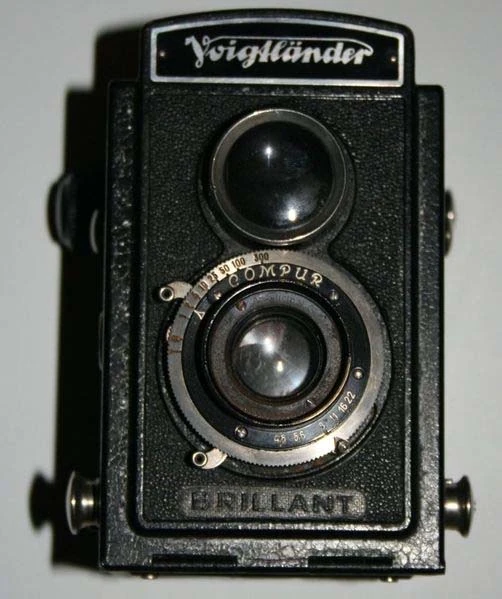

Voigtländer Brillant twin-lens reflex camera.
Twin lens reflex
Twin-lens reflex cameras use an objective lens and a focusing lens unit (usually identical to the objective lens) in a parallel body for composition and focusing. View cameras use a ground glass screen which is removed and replaced by either a photographic plate or a reusable holder containing sheet film before exposure.
Modern cameras often offer autofocus systems to focus the camera automatically by a variety of methods.
Exposure control
The size of the aperture and the brightness of the scene controls the amount of light that enters the camera during a period of time, and the shutter controls the length of time that the light hits the recording surface.
Equivalent exposures can be made with a larger aperture and a faster shutter speed or a corresponding smaller aperture and with the shutter speed slowed down.
History
Pinhole camera (11th–18th centuries)
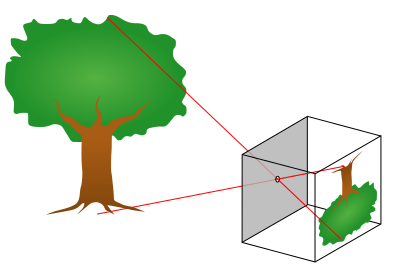

Pinhole camera. Light enters a dark box through a small hole and creates an inverted image on the wall opposite the hole.[1]
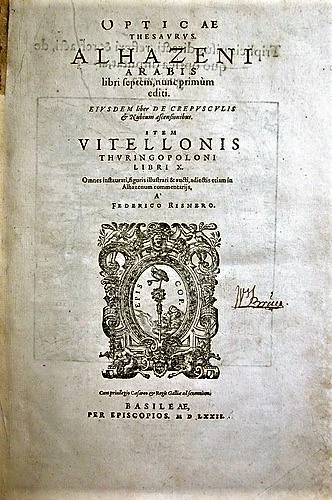

Ibn al-Haytham's Book of Optics (1021) in Latin translation.[2]
Ibn al-Haytham (c. 965–1040 AD), an Arab physicist also known as Alhazen, wrote very influential essays about the camera obscura, including experiments with light through a small opening in a darkened room.[3] The invention of the camera has been traced back to the work of Ibn al-Haytham,[4] who is credited with the invention of the pinhole camera.[5] While the effects of a single light passing through a pinhole had been described earlier,[4] Ibn al-Haytham gave the first correct analysis of the camera obscura,[6] including the first geometrical and quantitative descriptions of the phenomenon,[7] and was the first to use a screen in a dark room so that an image from one side of a hole in the surface could be projected onto a screen on the other side.[8] He also first understood the relationship between the focal point and the pinhole,[9] and performed early experiments with afterimages, laying the foundations for the invention of photography in the 19th century.[5]
Ibn al-Haytam's writings on optics became very influential in Europe through Latin translations, inspiring people such as Witelo, John Peckham, Roger Bacon, Leonardo Da Vinci, René Descartes and Johannes Kepler.[3] Camera obscuras were used as drawing aids since at least circa 1550. Since the late 17th century, portable camera obscura devices in tents and boxes were used as drawing aids.
Photographic camera (19th century)
The first permanent photograph of a camera image was made in 1825 by Joseph Nicéphore Niépce using a sliding wooden box camera made by Charles and Vincent Chevalier in Paris.[10]: 9–11 Niépce had been experimenting with ways to fix the images of a camera obscura since 1816. The photograph Niépce succeeded in creating shows the view from his window. It was made using an 8-hour exposure on pewter coated with bitumen.[10]: 9 Niépce called his process "heliography".[11]: 5 Niépce corresponded with the inventor Louis-Jacques-Mande Daguerre, and the pair entered into a partnership to improve the heliographic process. Niépce had experimented further with other chemicals, to improve contrast in his heliographs. Daguerre contributed an improved camera obscura design, but the partnership ended when Niépce died in 1833.[10]: 10 Daguerre succeeded in developing a high-contrast and extremely sharp image by exposing on a plate coated with silver iodide, and exposing this plate again to mercury vapor.[11]: 6 By 1837, he was able to fix the images with a common salt solution. He called this process Daguerreotype, and tried unsuccessfully for a couple years to commercialize it. Eventually, with help of the scientist and politician François Arago, the French government acquired Daguerre's process for public release. In exchange, pensions were provided to Daguerre as well as Niépce's son, Isidore.[10]: 11
In the 1830s, the English scientist Henry Fox Talbot independently invented a process to fix camera images using silver salts.[12]: 15 Although dismayed that Daguerre had beaten him to the announcement of photography, on January 31, 1839 he submitted a pamphlet to the Royal Institution entitled Some Account of the Art of Photogenic Drawing, which was the first published description of photography. Within two years, Talbot developed a two-step process for creating photographs on paper, which he called calotypes. The calotyping process was the first to utilize negative prints, which reverse all values in the photograph – black shows up as white and vice versa.[13]: 21 Negative prints allow, in principle, unlimited duplicates of the positive print to be made.[12]: 16 Calotyping also introduced the ability for a printmaker to alter the resulting image through retouching.[12]: 67 Calotypes were never as popular or widespread as daguerreotypes,[13]: 22 owing mainly to the fact that the latter produced sharper details.[14]: 370 However, because daguerreotypes only produce a direct positive print, no duplicates can be made. It is the two-step negative/positive process that formed the basis for modern photography.[15]: 15
The first photographic camera developed for commercial manufacture was a daguerreotype camera, built by Alphonse Giroux in 1839. Giroux signed a contract with Daguerre and Isidore Niépce to produce the cameras in France,[16]: 8–9 with each device and accessories costing 400 francs.[17]: 38 The camera was a double-box design, with a landscape lens fitted to the outer box, and a holder for a ground glass focusing screen and image plate on the inner box. By sliding the inner box, objects at various distances could be brought to as sharp a focus as desired. After a satisfactory image had been focused on the screen, the screen was replaced with a sensitized plate. A knurled wheel controlled a copper flap in front of the lens, which functioned as a shutter. The early daguerreotype cameras required long exposure times, which in 1839 could be from 5 to 30 minutes.[16][17]: 39
Analog camera (20th century)
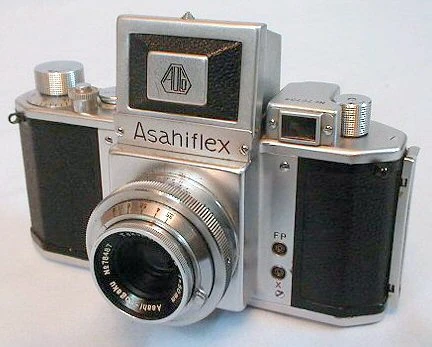

Asahiflex IIb, 1954
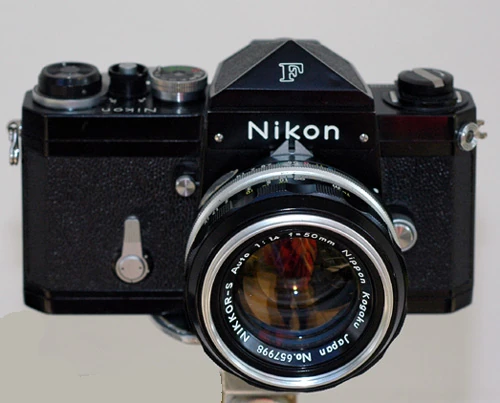

Nikon F of 1959 — the first Japanese system camera.
The fledgling Japanese camera industry began to take off in 1936 with the Canon 35 mm rangefinder, an improved version of the 1933 Kwanon prototype. Japanese cameras would begin to become popular in the West after Korean War veterans and soldiers stationed in Japan brought them back to the United States and elsewhere.
The first 35mm SLR was Soviet "Sport" camera in the 1930s. The 35mm SLR design gained immediate popularity and there was an explosion of new models and innovative features after World War II.
In 1952, the Asahi Optical Company (which later became well known for its Pentax cameras) introduced the first Japanese SLR using 135 film, the Asahiflex. Several other Japanese camera makers also entered the SLR market in the 1950s, including Canon, Yashica, and Nikon. Nikon's entry, the Nikon F, had a full line of interchangeable components and accessories and is generally regarded as the first Japanese system camera. It was the F, along with the earlier S series of rangefinder cameras, that helped establish Nikon's reputation as a maker of professional-quality equipment.
Through-the-lens metering ultimately became a feature more commonly found on SLRs than other types of camera. The first SLR equipped with a TTL system was the Topcon RE Super of 1962.
Analog electronic camera


Sony Mavica, 1981
Handheld electronic cameras, in the sense of a device meant to be carried and used like a handheld film camera, appeared in 1981 with the demonstration of the Sony Mavica (Magnetic Video Camera). This is not to be confused with the later cameras by Sony that also bore the Mavica name. This was an analog camera, in that it recorded pixel signals continuously, as videotape machines did, without converting them to discrete levels; it recorded television-like signals to a 2 × 2 inch "video floppy".[18] In essence it was a video movie camera that recorded single frames, 50 per disk in field mode and 25 per disk in frame mode. The image quality was considered equal to that of then-current televisions.
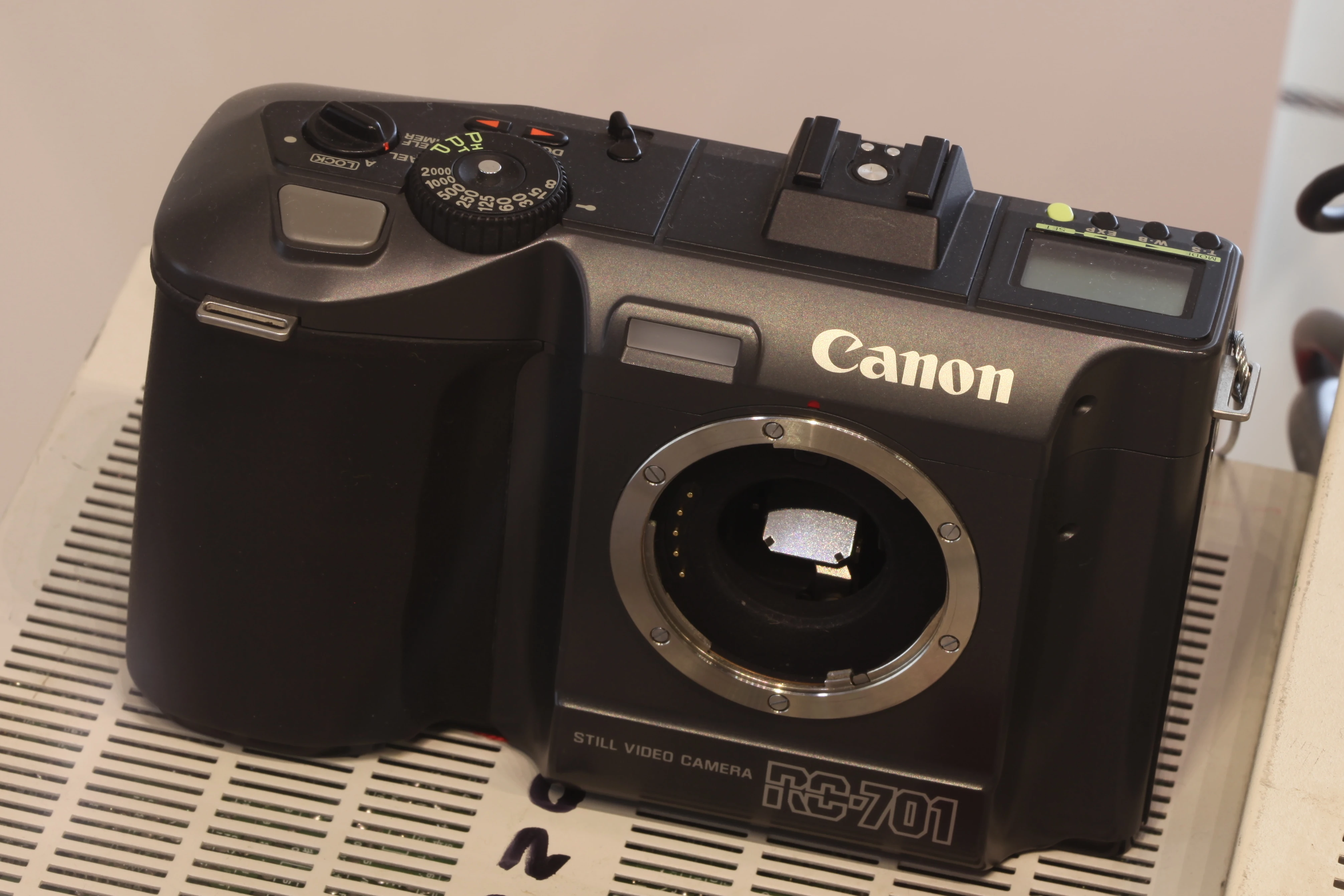

Canon RC-701, 1986
Analog electronic cameras do not appear to have reached the market until 1986 with the Canon RC-701. Canon demonstrated a prototype of this model at the 1984 Summer Olympics, printing the images in the Yomiuri Shinbun, a Japanese newspaper. In the United States, the first publication to use these cameras for real reportage was USA Today, in its coverage of World Series baseball. Several factors held back the widespread adoption of analog cameras; the cost (upwards of $20,000, 56000[19]), poor image quality compared to film, and the lack of quality affordable printers. Capturing and printing an image originally required access to equipment such as a frame grabber, which was beyond the reach of the average consumer. The "video floppy" disks later had several reader devices available for viewing on a screen, but were never standardized as a computer drive.
Digital imaging
- See also: Image sensor and Data compression
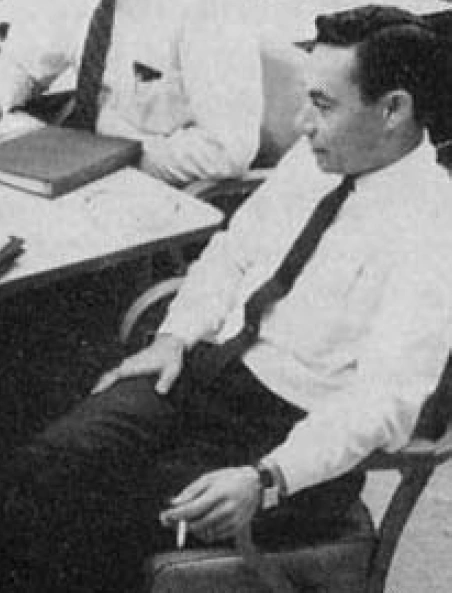

Mohamed M. Atalla invented the MOS transistor (1959) and MOS integrated circuit (1960), the basis for digital image sensors.
The basis for digital camera image sensors is metal-oxide-semiconductor (MOS) technology,[20] which originates from the invention of the MOSFET (MOS field-effect transistor) by Mohamed M. Atalla and Dawon Kahng at Bell Labs in 1959.[21] This led to the development of digital semiconductor image sensors, including the charge-coupled device (CCD) and later the CMOS sensor.[20]
The first semiconductor image sensor was the CCD, developed by Willard S. Boyle and George E. Smith at Bell Labs in 1969.[22] While researching MOS technology, they realized that an electric charge was the analogy of the magnetic bubble and that it could be stored on a tiny MOS capacitor. As it was fairly straighforward to fabricate a series of MOS capacitors in a row, they connected a suitable voltage to them so that the charge could be stepped along from one to the next.[23] The CCD is a semiconductor circuit that was later used in the first digital video cameras for television broadcasting.[24]
The NMOS active-pixel sensor (APS) was invented by Olympus in Japan during the mid-1980s. This was enabled by advances in MOS semiconductor device fabrication, with MOSFET scaling reaching smaller micron and then sub-micron levels.[25][26] The NMOS APS was fabricated by Tsutomu Nakamura's team at Olympus in 1985.[27] The CMOS active-pixel sensor (CMOS sensor) was later developed by Eric Fossum's team at the NASA Jet Propulsion Laboratory in 1993.[28][25]
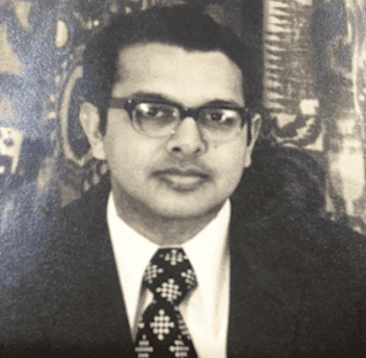

Nasir Ahmed invented the discrete cosine transform (DCT) in 1972. DCT is the basis for most image compression formats.
Practical digital cameras were enabled by advances in data compression, due to the impractically high memory and bandwidth requirements of uncompressed images and video.[29] The most important compression algorithm is the discrete cosine transform (DCT),[29][30] a lossy compression technique that was first proposed by Nasir Ahmed while he was working at the University of Texas in 1972.[31] Practical digital cameras were enabled by DCT-based compression standards, including the H.26x and MPEG video coding standards introduced from 1988 onwards,[30] and the JPEG image compression standard introduced in 1992.[32][33]
Digital camera
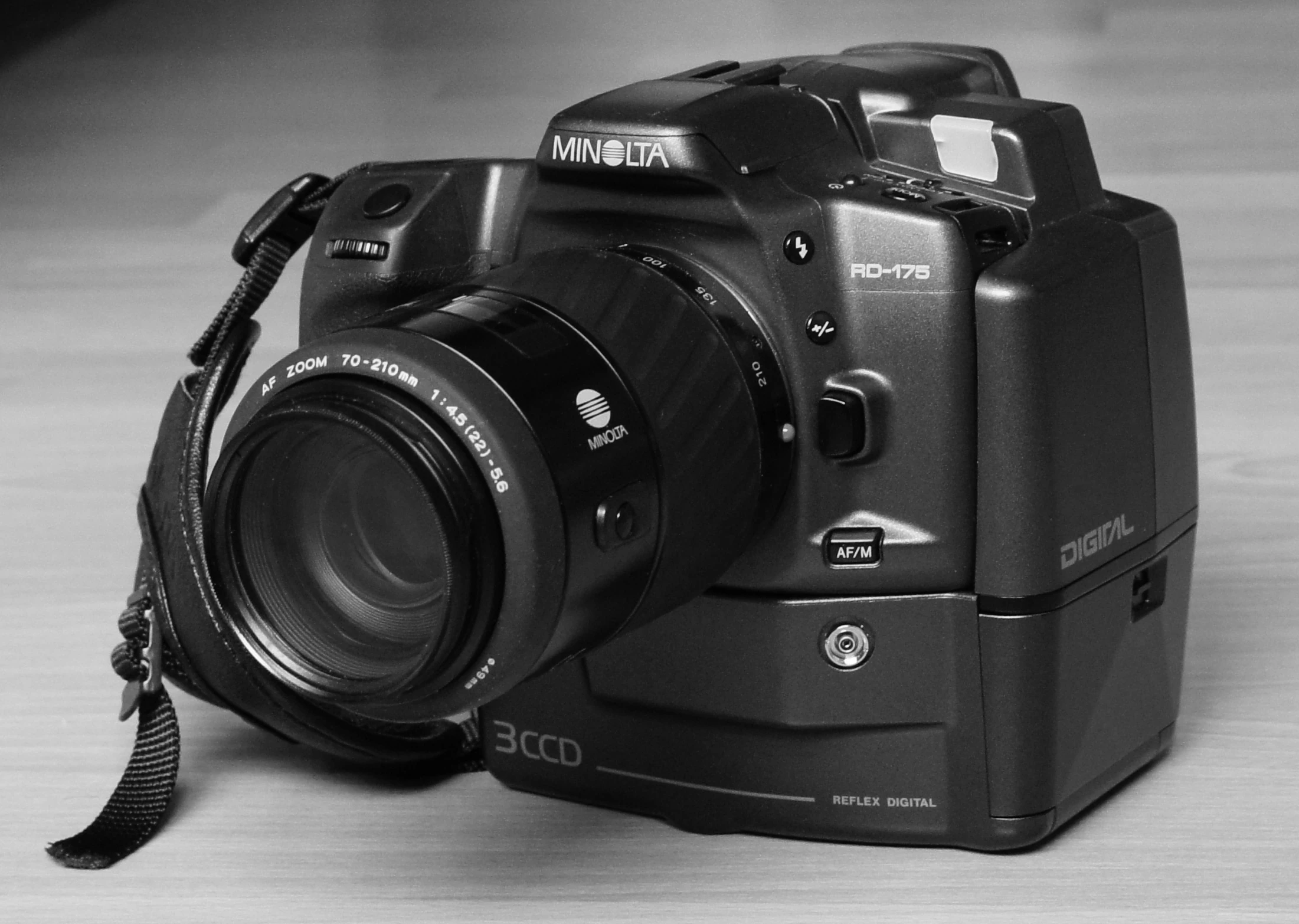

The first portable digital SLR camera, introduced by Minolta in 1995.
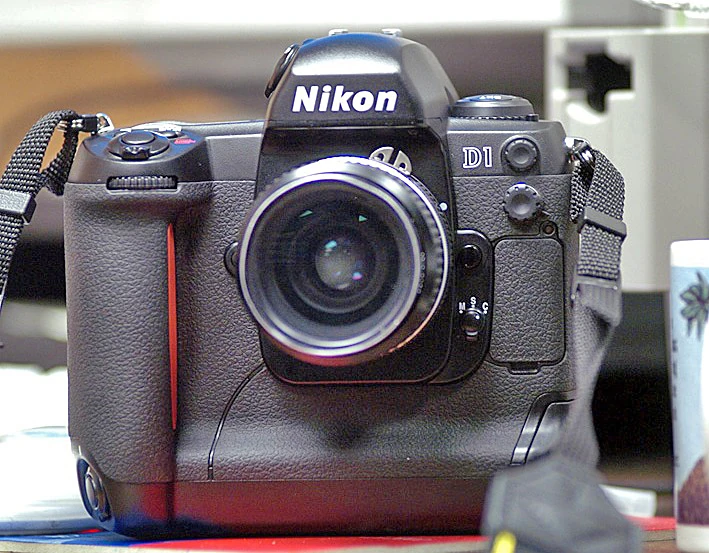

Nikon D1, 1999
By the late 1980s, the technology required to produce truly commercial digital cameras existed. The first true portable digital camera that recorded images as a computerized file was likely the Fuji DS-1P of 1988, which recorded to a 2 MB SRAM (static RAM) memory card that used a battery to keep the data in memory. This camera was never marketed to the public.
The first portable digital camera that was marketed commercially was sold in December 1989 in Japan, the DS-X by Fuji.[34] The first commercially available portable digital camera in the United States was the Dycam Model 1, first shipped in November 1990.[35] It was originally a commercial failure because it was black-and-white, low in resolution, and cost nearly $1,000 (2300[19]).[36] It later saw modest success when it was re-sold as the Logitech Fotoman in 1992. It used a CCD image sensor, stored pictures digitally, and connected directly to a computer for download.[37][38][39]
Nikon was interested in digital photography since the mid-1980s. In 1986, while presenting to Photokina, Nikon introduced an operational prototype of the first SLR-type digital camera (Still Video Camera), manufactured by Panasonic.[40] The Nikon SVC was built around a sensor 2/3 " charge-coupled device of 300,000 pixels. Storage media, a magnetic floppy inside the camera allows recording 25 or 50 B&W images, depending of the definition.[41] In 1988, Nikon released the first commercial DSLR camera, the QV-1000C.[40]
The move to digital formats was helped by the formation of the first JPEG and MPEG standards in 1988, based on discrete cosine transform (DCT) data compression, which allowed image and video files to be compressed for storage. The first consumer camera with a liquid crystal display on the back was the Casio QV-10 developed by a team led by Hiroyuki Suetaka in 1995. The first camera that offered the ability to record video clips may have been the Ricoh RDC-1 in 1995.
In 1995, Minolta introduced the RD-175, which was based on the Minolta 500si SLR with a splitter and three independent CCDs. This combination delivered 1.75M pixels. The benefit of using an SLR base was the ability to use any existing Minolta AF mount lens. 1999 saw the introduction of the Nikon D1, a 2.74 megapixel camera that was the first digital SLR developed entirely from the ground up by a major manufacturer, and at a cost of under $6,000 (12000[19]) at introduction was affordable by professional photographers and high-end consumers. This camera also used Nikon F-mount lenses, which meant film photographers could use many of the same lenses they already owned.
The first full-frame digital SLR cameras were developed in Japan from around 2000 to 2002: the MZ-D by Pentax,[42] the N Digital by Contax's Japanese R6D team,[43] and the EOS-1Ds by Canon.[44] Gradually in the 2000s, the full-frame DSLR became the dominant camera type for professional photography.
Camera phone
The first commercial camera phone was the Kyocera Visual Phone VP-210, released in Japan in May 1999.[45] It was called a "mobile videophone" at the time,[46] and had a 110,000-pixel front-facing camera.[45] It stored up to 20 JPEG digital images, which could be sent over e-mail, or the phone could send up to two images per second over Japan's Personal Handy-phone System (PHS) cellular network.[45] The Samsung SCH-V200, released in South Korea in June 2000, was also one of the first phones with a built-in camera. It had a TFT liquid-crystal display (LCD) and stored up to 20 digital photos at 350,000-pixel resolution. However, it could not send the resulting image over the telephone function, but required a computer connection to access photos.[47] The first mass-market camera phone was the J-SH04, a Sharp J-Phone model sold in Japan in November 2000.[48][47] It could instantly transmit pictures via cell phone telecommunication.[49]
One of the major technology advances was the development of CMOS sensors, which helped drive sensor costs low enough to enable the widespread adoption of camera phones. Smartphones now routinely include high resolution digital cameras.
References
- ↑ Kirkpatrick, Larry D.; Francis, Gregory E. (2007). "Light". Physics: A World View (6 ed.). Belmont, California: Thomson Brooks/Cole. p. 339. ISBN 978-0-495-01088-3.
- ↑ Friedrich Risner, publ. 1572. Opticae Thesaurus: Alhazeni Arabis Libri Septem Nunc Primum Editi, Eiusdem Liber De Crepusculis Et Nubium Asensionibus . Item Vitellonis Thuringopoloni Libri X. e-rara link. See Sabra, the authorship of Liber de crepusculis
- ↑ 3.0 3.1 Plott, John C. (1984). Global History of Philosophy: The Period of scholasticism (part one). p. 460. ISBN 978-0-89581-678-8.
- ↑ 4.0 4.1 Belbachir, Ahmed Nabil (2009). Smart Cameras. Springer Science & Business Media. ISBN 978-1-4419-0953-4.
The invention of the camera can be traced back to the 10th century when the Arab scientist Al-Hasan Ibn al-Haytham alias Alhacen provided the first clear description and correct analysis of the (human) vision process. Although the effects of single light passing through the pinhole have alrady been described by the Chinese Mozi (Lat. Micius) (5th century B), the Greek Aristotle (4th century BC), and the Arab
- ↑ 5.0 5.1 Plott, John C. (1984). Global History of Philosophy: The Period of scholasticism (part one). p. 460. ISBN 978-0-89581-678-8.
According to Nazir Ahmed if only Ibn-Haitham's fellow-workers and students had been as alert as he, they might even have invented the art of photography since al-Haitham's experiments with convex and concave mirrors and his invention of the "pinhole camera" whereby the inverted image of a candle-flame is projected were among his many successes in experimentation. One might likewise almost claim that he had anticipated much that the nineteenth century Fechner did in experimentation with after-images.
- ↑ Wade, Nicholas J.; Finger, Stanley (2001), "The eye as an optical instrument: from camera obscura to Helmholtz's perspective", Perception, 30 (10): 1157–1177, doi:10.1068/p3210, PMID 11721819,
The principles of the camera obscura first began to be correctly analysed in the eleventh century, when they were outlined by Ibn al-Haytham.
- ↑ Needham, Joseph. Science and Civilization in China, vol. IV, part 1: Physics and Physical Technology (PDF). p. 98. Archived from the original (PDF) on 3 July 2017. Retrieved 5 September 2016.
Alhazen used the camera obscura particularly for observing solar eclipses, as indeed Aristotle is said to have done, and it seems that, like Shen Kua, he had predecessors in its study, since he did not claim it as any new finding of his own. But his treatment of it was competently geometrical and quantitative for the first time.
- ↑ "Who Invented Camera Obscura?". Photography History Facts.
All these scientists experimented with a small hole and light but none of them suggested that a screen is used so an image from one side of a hole in surface could be projected at the screen on the other. First one to do so was Alhazen (also known as Ibn al-Haytham) in 11th century.
- ↑ Needham, Joseph. Science and Civilization in China, vol. IV, part 1: Physics and Physical Technology (PDF). p. 99. Archived from the original (PDF) on 3 July 2017. Retrieved 5 September 2016.
The genius of Shen Kua's insight into the relation of focal point and pinhole can better be appreciated when we read in Singer that this was first understood in Europe by Leonardo da Vinci (+ 1452 to + 1519), almost five hundred years later. A diagram showing the relation occurs in the Codice Atlantico, Leonardo thought that the lens of the eye reversed the pinhole effect, so that the image did not appear inverted on the retina; though in fact it does. Actually, the analogy of focal-point and pin-point must have been understood by Ibn al-Haitham, who died just about the time when Shen Kua was born.
- ↑ 10.0 10.1 10.2 10.3 Gernsheim, Helmut (1986). A Concise History of Photography (3 ed.). Mineola, New York: Dover Publications, Inc. ISBN 978-0-486-25128-8.
- ↑ 11.0 11.1 Gustavson, Todd (2009). Camera: a history of photography from daguerreotype to digital. New York: Sterling Publishing Co., Inc. ISBN 978-1-4027-5656-6.
- ↑ 12.0 12.1 12.2 Hirsch, Robert (2000). Seizing the Light: A History of Photography. New York: McGraw-Hill Companies, Inc. ISBN 978-0-697-14361-7.
- ↑ 13.0 13.1 Gustavson, Todd (2009). Camera: a history of photography from daguerreotype to digital. New York: Sterling Publishing Co., Inc. ISBN 978-1-4027-5656-6.
- ↑ London, Barbara; Upton, John; Kobré, Kenneth; Brill, Betsy (2002). Photography (7 ed.). Upper Saddle River, New Jersey: Prentice Hall. ISBN 978-0-13-028271-2.
- ↑ Gernsheim, Helmut (1986). A Concise History of Photography (3 ed.). Mineola, New York: Dover Publications, Inc. ISBN 978-0-486-25128-8.
- ↑ 16.0 16.1 Gustavson, Todd (2009). Camera: a history of photography from daguerreotype to digital. New York: Sterling Publishing Co., Inc. ISBN 978-1-4027-5656-6.
- ↑ 17.0 17.1 Frizot, Michel (January 1998). "Light machines: On the threshold of invention". A New History of Photography. Koln, Germany: Konemann. ISBN 978-3-8290-1328-4.
{{cite book}}: Unknown parameter|editors=ignored (|editor=suggested) (help) - ↑ Kenji Toyoda (2006). "Digital Still Cameras at a Glance". In Junichi Nakamura (ed.). Image sensors and signal processing for digital still cameras. CRC Press. p. 5. ISBN 978-0-8493-3545-7.
- ↑ 19.0 19.1 19.2 1634–1699: McCusker, J. J. (1997). How Much Is That in Real Money? A Historical Price Index for Use as a Deflator of Money Values in the Economy of the United States: Addenda et Corrigenda (PDF). American Antiquarian Society. 1700–1799: McCusker, J. J. (1992). How Much Is That in Real Money? A Historical Price Index for Use as a Deflator of Money Values in the Economy of the United States (PDF). American Antiquarian Society. 1800–present: Federal Reserve Bank of Minneapolis. "Consumer Price Index (estimate) 1800–". Retrieved February 29, 2024.
- ↑ 20.0 20.1 Williams, J. B. (2017). The Electronics Revolution: Inventing the Future. Springer. pp. 245–8. ISBN 9783319490885.
- ↑ "1960: Metal Oxide Semiconductor (MOS) Transistor Demonstrated". The Silicon Engine. Computer History Museum. Retrieved August 31, 2019.
- ↑ James R. Janesick (2001). Scientific charge-coupled devices. SPIE Press. pp. 3–4. ISBN 978-0-8194-3698-6.
- ↑ Williams, J. B. (2017). The Electronics Revolution: Inventing the Future. Springer. pp. 245–8. ISBN 9783319490885.
- ↑ Boyle, William S; Smith, George E. (1970). "Charge Coupled Semiconductor Devices". Bell Syst. Tech. J. 49 (4): 587–593. doi:10.1002/j.1538-7305.1970.tb01790.x.
- ↑ 25.0 25.1 Fossum, Eric R. (12 July 1993). Blouke, Morley M. (ed.). "Active pixel sensors: are CCDs dinosaurs?". SPIE Proceedings Vol. 1900: Charge-Coupled Devices and Solid State Optical Sensors III. International Society for Optics and Photonics: 2–14. CiteSeerX 10.1.1.408.6558. doi:10.1117/12.148585.
- ↑ Fossum, Eric R. (2007). "Active Pixel Sensors" (PDF). Semantic Scholar. Retrieved 8 October 2019.
- ↑ Matsumoto, Kazuya; et al. (1985). "A new MOS phototransistor operating in a non-destructive readout mode". Japanese Journal of Applied Physics. 24 (5A): L323. Bibcode:1985JaJAP..24L.323M. doi:10.1143/JJAP.24.L323.
- ↑ Fossum, Eric R.; Hondongwa, D. B. (2014). "A Review of the Pinned Photodiode for CCD and CMOS Image Sensors". IEEE Journal of the Electron Devices Society. 2 (3): 33–43. doi:10.1109/JEDS.2014.2306412.
- ↑ 29.0 29.1 Belmudez, Benjamin (2014). Audiovisual Quality Assessment and Prediction for Videotelephony. Springer. pp. 11–13. ISBN 9783319141664.
- ↑ 30.0 30.1 Huang, Hsiang-Cheh; Fang, Wai-Chi (2007). Intelligent Multimedia Data Hiding: New Directions. Springer. p. 41. ISBN 9783540711698.
- ↑ Ahmed, Nasir (January 1991). "How I Came Up With the Discrete Cosine Transform". Digital Signal Processing. 1 (1): 4–5. doi:10.1016/1051-2004(91)90086-Z.
- ↑ Hudson, Graham; Léger, Alain; Niss, Birger; Sebestyén, István; Vaaben, Jørgen (31 August 2018). "JPEG-1 standard 25 years: past, present, and future reasons for a success". Journal of Electronic Imaging. 27 (4): 1. doi:10.1117/1.JEI.27.4.040901.
- ↑ "What Is a JPEG? The Invisible Object You See Every Day". The Atlantic. 24 September 2013. Retrieved 13 September 2019.
- ↑ History of the digital camera and digital imaging
- ↑ "Digital cameras, the next wave. (Electronic Imaging Issue; includes related articles) | HighBeam Business: Arrive Prepared". web.archive.org.
- ↑ Inc, InfoWorld Media Group (12 August 1991). "InfoWorld". InfoWorld Media Group, Inc. – via Google Books.
{{cite web}}:|last=has generic name (help) - ↑ "History of the digital camera and digital imaging". The Digital Camera Museum.
- ↑ "Dycam Model 1: The world's first consumer digital still camera". DigiBarn computer museum.
- ↑ Carolyn Said, "DYCAM Model 1: The first portable Digital Still Camera", MacWeek, vol. 4, No. 35, 16 Oct. 1990, p. 34.
- ↑ 40.0 40.1 David D. Busch (2011), Nikon D70 Digital Field Guide, page 11, John Wiley & Sons
- ↑ Nikon SLR-type digital cameras, Pierre Jarleton
- ↑ The long, difficult road to Pentax full-frame The long, difficult road to Pentax full-frame, Digital Photography Review
- ↑ British Journal of Photography, Issues 7410-7422, 2003, p. 2
- ↑ Canon EOS-1Ds, 11 megapixel full-frame CMOS, Digital Photography Review
- ↑ 45.0 45.1 45.2 "Camera phones: A look back and forward". Computerworld. 11 May 2012. Retrieved 15 September 2019.
- ↑ "First mobile videophone introduced". CNN. May 18, 1999. Retrieved 15 September 2019.
- ↑ 47.0 47.1 "From J-Phone to Lumia 1020: A complete history of the camera phone". Digital Trends. August 11, 2013. Retrieved 15 September 2019.
- ↑ "Evolution of the Camera phone: From Sharp J-SH04 to Nokia 808 Pureview". Hoista.net. 2012-02-28. Archived from the original on 2013-07-31. Retrieved 2013-06-21.
- ↑ "Taking pictures with your phone". BBC News. BBC. 18 September 2001. Retrieved 15 September 2019.