A wheel is a rotating component (typically circular in shape) that is intended to turn on an axle bearing. The wheel is one of the key components of the wheel and axle which is one of the six simple machines. Wheels, in conjunction with axles, allow heavy objects to be moved easily facilitating movement or transportation while supporting a load, or performing labor in machines. Wheels are also used for other purposes, such as a ship's wheel, steering wheel, potter's wheel, and flywheel.
Most scholars regard the wheel as one of the oldest and most important inventions. Common examples can be found in transport applications. A wheel reduces friction by facilitating motion by rolling together with the use of axles. In order for wheels to rotate, a moment needs to be applied to the wheel about its axis, either by way of gravity or by the application of another external force or torque.
History
One of the first applications of the wheel to appear was the potter's wheel, used by prehistoric cultures to fabricate clay pots. The earliest type, known as "tournettes" or "slow wheels", were known in the Middle East by the 5th millennium BC. One of the earliest examples was discovered at Tepe Pardis, Iran, and dated to 5200–4700 BC. These were made of stone or clay and secured to the ground with a peg in the center, but required significant effort to turn. True potter's wheels, which are freely-spinning and have a wheel and axle mechanism, were developed in Mesopotamia (Iraq) by 4200–4000 BC.[1] The oldest surviving example, which was found in Ur (modern day Iraq), dates to approximately 3100 BC.[2]
The Halaf culture of 6500–5100 BC (in Syria) has been credited with the earliest possible depiction of a wheeled vehicle, but the evidence is unclear.[3] Clear evidence of wheeled vehicles appeared by mid-4th millennium BC. Depictions of wheeled wagons found on clay tablet pictographs at the Eanna district of Uruk, in the Sumerian civilization of Mesopotamia, are dated between 3700–3500 BC.[4] The wheel spread through Western Asia in the 4th millennium BC, and reached the Indus Valley of the Indian subcontinent by the 3rd millennium BC.
Historians believe that there was a diffusion of the wheeled vehicle from the Near East to Europe in the late 4th millennium BC.[5] In China, the earliest evidence of spoked wheels comes from Qinghai in the form of two wheel hubs from a site dated between 2000 and 1500 BC.[6]
In Roman Egypt, Hero of Alexandria identified the wheel and axle as one of the simple machines used to lift weights.[7] This is thought to have been in the form of the windlass which consists of a crank or pulley connected to a cylindrical barrel that provides mechanical advantage to wind up a rope and lift a load such as a bucket from the well.[8] The wheel and axle was identified as one of six simple machines by Renaissance scientists, drawing from Greek texts on technology.[9]
The invention of the wheel has also been important for technology in general, important applications including the water wheel, the cogwheel (see also antikythera mechanism), the spinning wheel, and the astrolabe or torquetum. More modern descendants of the wheel include the propeller, the jet engine, the flywheel (gyroscope) and the turbine.
Etymology
The English word wheel comes from the Proto-Indo-European [*kwekwlo-] Error: {{Lang}}: text has italic markup (help),[10] which was an extended form of the root [*kwel-] Error: {{Lang}}: text has italic markup (help) meaning "to revolve, move around". This is also the root of the Greek κυκλος kuklos, the Sanskrit chakra, and Persian charkh, all meaning "circle" or "wheel",[11] and also in Lithuanian, sukti means "to rotate". The Latin word rota is from the Proto-Indo-European [*rotā-] Error: {{Lang}}: text has italic markup (help), the extended o-grade form of the root [*ret-] Error: {{Lang}}: text has italic markup (help) meaning "to roll, revolve".[12]
Mathematics
The critical angle can be found by solving the equation:


where
- is the radius of the wheels;
- is the horizontal distance of the center of mass from the rear axle; and
- is the vertical distance of the center of mass from the axles.


For small wheels, this formula can be simplified to:
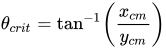
The maximum height of an obstacle can be found by the equation:


where is the wheelbase.

In symbology
The wheel has also become a strong cultural and spiritual metaphor for a cycle or regular repetition (see chakra, reincarnation, Yin and Yang among others). As such and because of the difficult terrain, wheeled vehicles were forbidden in old Tibet.
The winged wheel is a symbol of progress, seen in many contexts including the coat of arms of Panama and the logo of the Ohio State Highway Patrol.
The introduction of spoked (chariot) wheels in the Middle Bronze Age appear to have carried somewhat of a prestige. The solar wheel appears to have a significance in Bronze Age religion, replacing the earlier concept of a Solar barge with the more "modern" and technologically advanced solar chariot.
The wheel is also the prominent figure on the flag of India. The wheel in this case represents law (dharma). It also appears in the flag of the Romani people, hinting to their nomadic history and their Indian origins. The wheel can also appears in the flag of Mahl Kshatiyas Kings (kattiri buvana maha radun).
In recent times, the custom aftermarket car/automobile roadwheel has become a status symbol. These wheels are often incorrectly referred to as "rims". The term "rim" is incorrect because the rim is only the outer portion of a wheel (where the tire is mounted), just as with a coffee cup or meteor crater. These "rims" have a great deal of variation, and are often highly polished and very shiny. Some custom "rims" include a bearing-mounted, free-spinning disc which continues to rotate by inertia after the automobile is stopped. In slang, these are referred to as "Spinners".
References

- ↑ D.T. Potts (2012). A Companion to the Archaeology of the Ancient Near East. p. 285.
- ↑ Moorey, Peter Roger Stuart (1999) [1994]. Ancient Mesopotamian Materials and Industries: The Archaeological Evidence. Winona Lake, IN: Eisenbrauns. p. 146. ISBN 978-1-57506-042-2.
- ↑ V. Gordon Childe (1928). New Light on the Most Ancient East. p. 110.
- ↑ Attema, P. A. J.; Los-Weijns, Ma; Pers, N. D. Maring-Van der (December 2006). "Bronocice, Flintbek, Uruk, JEbel Aruda and Arslantepe: The Earliest Evidence Of Wheeled Vehicles In Europe And The Near East". Palaeohistoria. University of Groningen. 47/48: 10–28 (11). ISBN 9789077922187.
- ↑ Attema, P. A. J.; Los-Weijns, Ma; Pers, N. D. Maring-Van der (December 2006). "Bronocice, Flintbek, Uruk, JEbel Aruda and Arslantepe: The Earliest Evidence Of Wheeled Vehicles In Europe And The Near East". Palaeohistoria. University of Groningen. 47/48: 10–28 (19–20). ISBN 9789077922187.
- ↑ "Chinese Bronze Age Wheeled Vehicles". www.sino-platonic.org. Retrieved 2022-01-28.
- ↑ Usher, Abbott Payson (1988). A History of Mechanical Inventions. US: Courier Dover Publications. p. 98. ISBN 048625593X.
- ↑ Elroy McKendree Avery, Elementary Physics, New York : Sheldon & Company, 1878.
- ↑ Wheel and Axle, The World Book Encyclopedia, World Book Inc., 1998, pp. 280–281
- ↑ "wheel". Online Etymology Dictionary.
- ↑ kwel-1. The American Heritage Dictionary of the English Language: Fourth Edition. 2000
- ↑ ret- The American Heritage Dictionary of the English Language: Fourth Edition. 2000