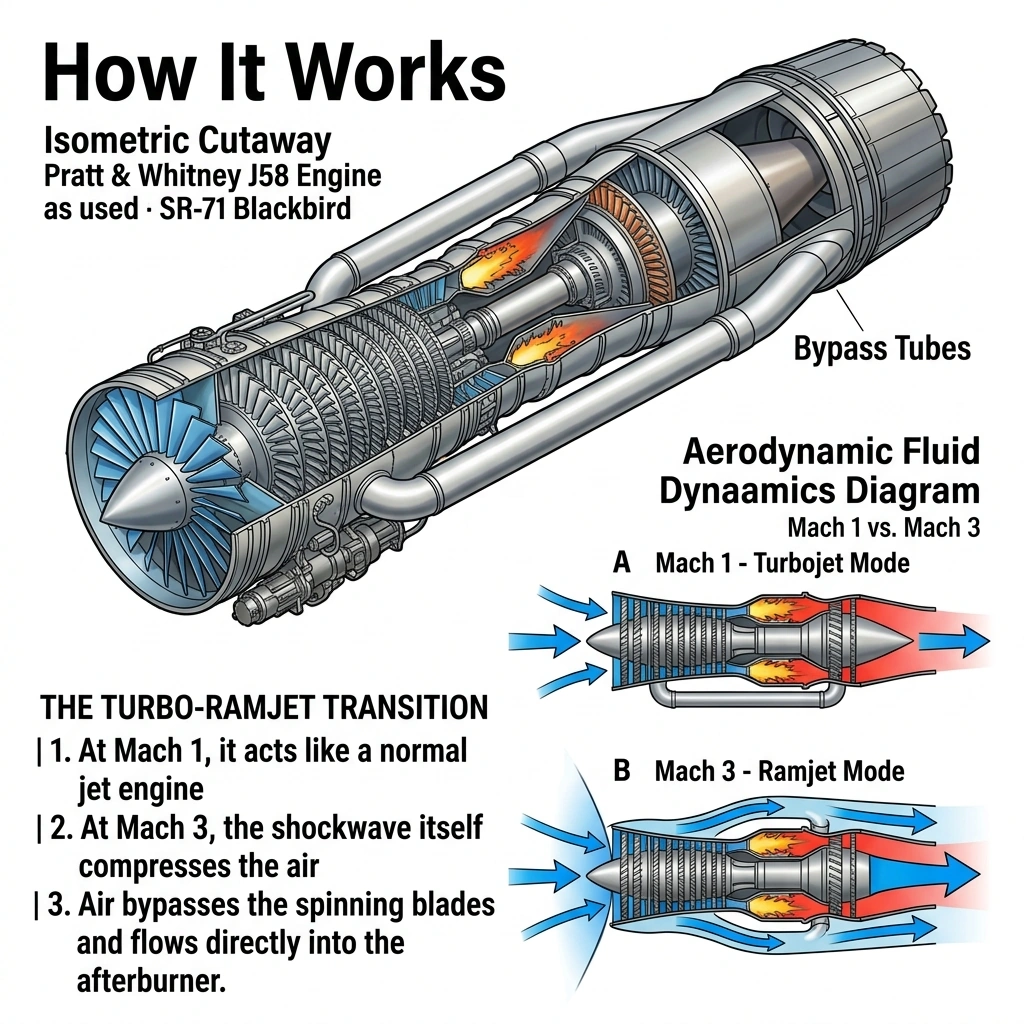

A turboramjet / air turborocket is a hybrid aircraft engine that combines a turbojet core inside a ramjet duct to operate efficiently from standstill up to high supersonic speeds. It solves the primary limitation of a standard ramjet—which cannot produce thrust at zero speed—while allowing the aircraft to surpass the speed limits of a traditional turbojet.
How It Works
The engine dynamically transitions between two main modes of flight:
- Turbojet Mode (Take-off to Mach 2-3): At low speeds, air entering the intake is directed into the turbojet core. A turbine-driven compressor squeezes the air, mixes it with fuel, and ignites it to generate thrust.
- Ramjet Mode (Above Mach 3): At high speeds, mechanical compressors become a bottleneck and choke the airflow. Control flaps bypass the air around the turbojet core entirely. The extreme speed of the aircraft naturally compresses ("rams") the incoming air. Fuel is injected directly into this bypassed stream and ignited in a downstream combustion chamber/afterburner.
Operational Advantages
- Broad Speed Profile: It is a true "zero-to-high-Mach" solution.
- High-Speed Efficiency: It functions where conventional turbofans melt or fail.
- Reduced Complexity: Merging the structures shares the intake and nozzle.
Historical and Modern Use
- Pratt & Whitney J58: Famously powered the Lockheed SR-71 Blackbird. While technically an afterburning turbojet with unique bleed tubes, it redirected compressor air to the afterburner at high speeds, making it behave exactly like a turboramjet during Mach 3.2 (2,455 mph) cruise.
- Brandner E-300: Turbojet with bypass tubes for the proposed Helwan HA-300 fighter jet enabling speeds of Mach 2.1 (1611.27mph).
- Hermoine Chimera: Developed by Hermeus, this modern turbine-based combined cycle (TBCC) engine integrates a commercial turbojet with a ramjet to power hypersonic flight test vehicles.