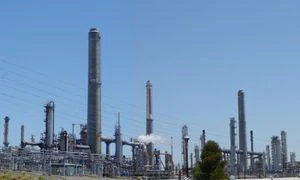

View of Shell Oil Refinery in Martinez, California.
An oil refinery is an industrial process plant where crude oil is processed and refined into useful petroleum products, such as gasoline and diesel fuel.
Operation
Raw oil or unprocessed ("crude") oil is not very useful in the form it comes in out of the ground. It needs to be broken down into parts and refined before use in a solid material such as plastics [1] and foams [2], or as petroleum fossil fuels as in the case of automobile and airplane engines.
Oil can be used in so many various ways because it contains hydrocarbons [3] of varying molecular masses [4] and lengths such as paraffins [5], aromatics [6], naphthenes [7] (or cycloalkanes [8]), alkenes [9], dienes [10], and alkynes [11].
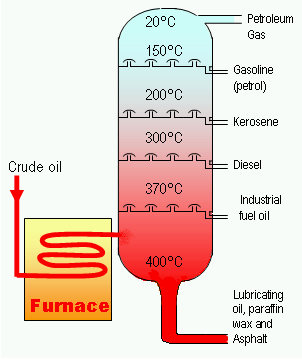

Crude oil is separated into fractions by fractional distillation. The fractioning column is cooler at the top than at the bottom so the vapours can condense more easily while the moving up the column. The heavier fractions that emerge from the bottom of the fractionating column are often broken up (cracked) to make more useful products.
Hydrocarbons are molecules of varying length and complexity made of hydrogen and carbon. Their various structures give them their differing properties and thereby uses. The trick in the oil refinement process is separating and purifying these. All these different hydrocarbons have different boiling points, which means they can be separated by distillation.
Once separated and any contaminants and impurities have been removed, the oil can be either sold without any further processing, or smaller molecules such as isobutane [12] and propylene [13] or butylenes [14] can be recombined to meet specific octane requirements by processes such as alkylation or less commonly, dimerization [15]. Octane can also be improved by catalytic reforming [16], which strips hydrogen out of hydrocarbons to produce aromatics [17], which have much higher octane ratings. Intermediate products such as gasoils can even be reprocessed to break a heavy, long-chained oil into a lighter short-chained one, by various forms of cracking [18] such as Fluid Catalytic Cracking, Thermal Cracking, and Hydrocracking. The final step in gasoline production is the blending of fuels with different octane ratings, vapor pressures, and other properties to meet product specifications.
Products of oil refinery
- Asphalt
- Diesel fuel
- Fuel oils
- Gasoline
- Kerosene
- Liquid petroleum gas (LPG)
- Lubricating oils
- Paraffin wax
- Tar
Safety and environmental concerns
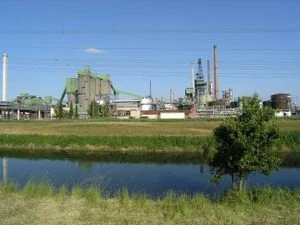

MiRO refinery at Karlsruhe
Oil refineries are typically large sprawling industrial complexes with extensive piping running throughout. The refining process releases numerous different chemicals into the atmosphere; consequently, there are substantial air pollution emissions and a notable odor normally accompanies the presence of a refinery. Aside from air pollution impacts there are also wastewater concerns, upset risks of fire and explosion, and both occupational noise and environmental noise health effects.
The public has demanded that many governments place restrictions on contaminants that refineries release, and most refineries have installed the equipment needed to comply with the requirements of the pertinent environmental protection regulatory agencies. In the United States, there is strong pressure to prevent the development of new refineries, and none have been built in the country for more than three decades. However, many existing refineries have been expanded during that time. It is likely that more stringent conditions will be placed on refineries in the future worldwide, leading to a change in the net energy balance of production against petroleum and in favor of ethanol fuel.
Environmental and safety concerns mean that oil refineries are sometimes located some distance away from major urban areas. Nevertheless, there are many instances where refinery operations are close to populated areas and pose health risks such as in Tenerife, Spain 1, which is sited in a densely-populated city center and next to the only two major evacuation routes in and out of the city. In California's Contra Costa County and Solano County, a shoreline necklace of refineries and associated chemical plants are adjacent to urban areas in Richmond, Martinez, California, Pacheco, Concord, Pittsburg, Vallejo and Benicia, with occasional accidental events that require "shelter in place" orders to the adjacent populations.
Common process units found in a refinery
- Atmospheric Distillation Unit (distills crude oil into fractions)
- Vacuum Distillation Unit (further distills residual bottoms after atmospheric distillation)
- Naphtha Hydrotreater Unit (desulfurizes naphtha from atmospheric distillation. Must hydrotreat the naphtha before sending to a Catalytic Reformer Unit.)
- Catalytic Reformer Unit (contains catalyst used to convert the naphtha-boiling range molecules into higher octane reformate (reformer product). The reformate has higher content of aromatics, olefins, and cyclic hydrocarbons). An important byproduct of a reformer is hydrogen released during the catalyst reaction. The hydrogen is used either in the hydrotreaters and hydrocracker. )
- Distillate Hydrotreater Unit (desulfurizes distillate (diesel) after atmospheric distillation)
- Fluid Catalytic Cracking (FCC) Unit (upgrades heavier fractions into lighter, more valuable products)
- Hydrocracker Unit (upgrades heavier fractions into lighter, more valuable products)
- Alkylation unit (produces high octane component for gasoline blending)
- Dimerization Unit
- Isomerization Unit
- Liquified gas storage units for propane and similar gaseous fuels at pressure sufficient to maintain in liquid form - these are usually spherical or bullets (horizontal cylinder with rounded ends).
- Storage tanks for crude oil and finished products, usually cylindrical, with some sort of vapor enclosure and surrounded by an earth berm to contain spills
- Utility units such as cooling towers for circulating cooling water, boiler plants for steam generation, and wastewater collection and treating systems to make such water suitable for reuse or for disposal
Specialized end product units
These will blend various feedstocks, mix appropriate additives, provide short term storage, and prepare for bulk loading to trucks, barges, product ships, and railcars.
- Gaseous fuels such as propane, stored and shipped in liquid form under pressure in specialized railcars to distributors.
- Liquid fuels blending (producing automotive and aviation grades of gasoline, kerosene, various aviation turbine fuels, and diesel fuels, adding dyes, detergents, antiknock additives, oxygenates, and anti-fungal compounds as required). Shipped by barge, rail, and tanker ship. May be shipped regionally in dedicated pipelines to point consumers, particularly aviation jet fuel to major airports, or piped to distributors in multi-product pipelines using product separators called pipeline inspection gauges ("pigs").
- Lubricants (produces light machine oils, motor oils, and greases, adding viscosity stabilizers as required), usually shipped in bulk to an offsite packaging plant.
- Wax, used in the packaging of frozen foods, among others. May be shipped in bulk to a site to prepare as packaged blocks.
- Sulphuric acid finishing and shipping. This is a useful industrial material, usually prepared as oleum, a byproduct of sulfur removal from fuels.
- Bulk tar shipping for offsite unit packaging for use in tar-and-gravel roofing.
- Asphalt unit. Prepares bulk asphalt for shipment.
- Asphalt concrete unit. Mixes asphalt with aggregate on demand to truck hot for local road surfacing use.
Co-plant siting
Frequently a chemical plant will be sited adjacent to a refinery, utilizing intermediate products as feedstocks for the production of specialized materials such as plastics or agrichemicals.
History
The world's first oil refinery opened at Ploieşti, Romania in 1856 [19].
The largest oil refinery in the world is in Ras Tanura, Saudi Arabia, owned by Saudi Aramco. The city was originally built as a sea port, but actually developed because of the huge refinery area. For most of the 20th century, the largest refinery of the world was that of Abadan in Iran.
See also
- Air pollution
- Cooling tower
- Ethanol fuel
- Gas flare
- List of oil refineries
- Net energy balance [20]
- Refinery
External links
- Complete, detailed refinery description
- Petroleum Refinery Planning and Optmization Using Linear Programming
- Student's Guide to Refining
Template:Commons
- Discover Petroleum, an educational site from the UK
- Short introduction to oil refining in a slideshow
- Ecomuseum Bergslagen - history of Oljeön, Sweden
- An example flowchart of fractions from crude oil at a refinery
References
- note label|Beychok|1|^}} {{cite book | author=Beychok Milton R. | title=Aqueous Wastes From Petroleum and Petrochemical Plants | edition=1st Edition | publisher=John Wiley & Sons | year=1967 | id= LCCN 67-19834.
| This page uses Creative Commons Licensed content from Wikipedia (view authors). | 
|