| Electron | |||||||||||||||
|---|---|---|---|---|---|---|---|---|---|---|---|---|---|---|---|
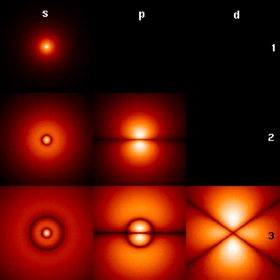 The first few hydrogen atom electron orbitals shown as cross-sections with color-coded probability density | |||||||||||||||
| Classification | |||||||||||||||
| |||||||||||||||
| Properties | |||||||||||||||
|

The electron is a fundamental subatomic particle that carries a negative electric charge. See also electron [1]
In industry
Electron beams are used in welding as well as lithography.
Usage
Electron microscopes are used to magnify details up to 500,000 times. Quantum effects of electrons are used in Scanning tunneling microscope to study features at the atomic scale.
See also
- Electron [2]
- Proton
- Neutron
- Photoelectric Effect
- Lightning
- Cathode rays
- Electricity
External links
- The Discovery of the Electron from the American Institute of Physics History Center
- Particle Data Group
- Stoney, G. Johnstone, "Of the 'Electron,' or Atom of Electricity". Philosophical Magazine. Series 5, Volume 38, p. 418-420 October 1894.
- Eric Weisstein's World of Physics: Electron
References
- Griffiths, David J. (2004). Introduction to Quantum Mechanics (2nd ed.). Prentice Hall. ISBN 013805326X.[3]
- Tipler, Paul; Llewellyn, Ralph (2002). Modern Physics (4th ed.). W. H. Freeman. ISBN 0716743450.
{{cite book}}: CS1 maint: multiple names: authors list (link)[4] - Brumfiel, G. (6 January 2005)[5]. Can electrons do the splits? In Nature, 433, 11.
| This page uses Creative Commons Licensed content from Wikipedia (view authors). | 
|